Cold plasma in medicine

How does cold atmospheric plasma work, where is it used and what does treatment involve?

At a glance

  • Cold, ionized gas inactivates bacteria, viruses and fungi physically, including multidrug-resistant pathogens.
  • Well established for chronic wounds such as diabetic foot syndrome and for inflammatory skin diseases.
  • Contact-free, usually painless and only a few minutes per session.

AWMF S2k guideline 007-107 (in German)

When wounds do not heal and antibiotics fail

For many people, it is an ordeal that lasts months or years: wounds that do not heal despite intensive care. At the same time, antibiotics are losing their effectiveness worldwide, and the search for an alternative to antibiotics is becoming more urgent.[6]

Cold plasma uses the fourth state of matter to combat pathogens physically rather than chemically. Because it attacks germs at several points at once, the development of resistance is less likely according to current knowledge.[2] This page provides an overview – you will find more detailed information on the linked topic pages.

Basics

What is cold plasma in simple terms?

We know matter as solid, liquid or gas. When a lot of energy is added to a gas, the fourth state of matter is created: plasma. In nature, it is hot, for example in the sun or in lightning. In medicine, it is made usable at body temperature.[5]

More about cold plasma technology

Physical process

Ions, electrons, radicals

Atoms and molecules split apart and electrons are released. This creates a reactive, electrically conductive mixture.

Combined action

Several factors at once

Medical devices generate this mixture from a noble gas such as argon or from ambient air: reactive species, weak electric fields and gentle UV radiation.

Temperature

Below 40 °C on the skin

The ionized gas cools down immediately. Thermal damage to the tissue is not to be expected when the device is used properly.

How cold plasma acts on wounds and tissue

Cold plasma combines two effects: it inactivates bacteria, viruses and fungi, including multidrug-resistant pathogens, and at the same time stimulates blood flow and cell division.[7, 8]

More about cold plasma therapy

Areas of use

  • Chronic wounds: diabetic foot syndrome, leg ulcers, pressure ulcers, impaired wound healing after surgery[1, 4]
  • Dermatology: infectious and inflammatory skin diseases[4] such as acne[14, 15], herpes[16] or nail fungus[17]
  • Dentistry: periodontitis[10] and peri-implantitis[11]
  • Special applications: tumor wounds in palliative care[4] and burns[12]
  • Veterinary medicine: hot spots, mud fever and postoperative wounds in animals[13]

Procedure and duration

What treatment feels like

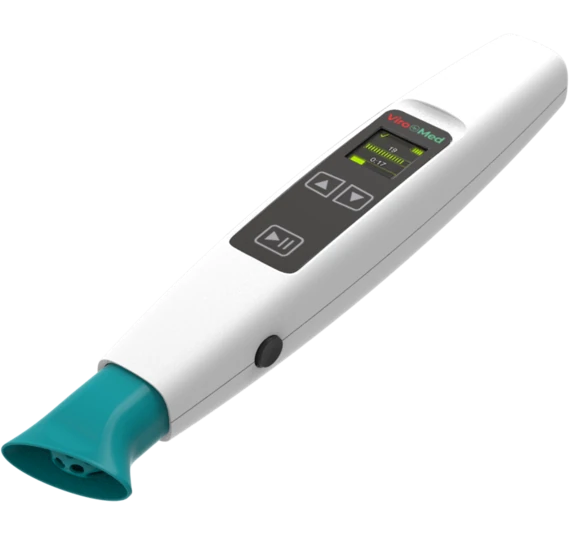
After the wound has been cleaned, the healthcare professional guides the handheld device over the area at a short distance without touching it. Handy systems allow precise guidance, even in hard-to-reach areas. In practice, acceptance among patients is high.

  1. 1

    What you feel

    Experience shows that the treatment is painless or causes very little pain. Usually, you only feel a gentle, cool breeze, occasionally a slight tingling – a sign of stimulated blood flow.

  2. 2

    What you smell

    During the application, a fleeting smell of ozone develops, similar to the air after a summer thunderstorm. It is part of the physical process.

  3. 3

    How long it takes

    A session usually lasts 60 to 180 seconds per wound area, often less for small areas. Depending on the findings, it is repeated two to three times a week.

How they differ

Cold plasma or plasma pen?

Two completely different technologies are often lumped together under the term “plasma.” The difference: the plasma pen deliberately destroys tissue in order to tighten it – cold plasma spares the tissue and supports its regeneration.

Plasma pen

Hot plasma with a thermal effect

So-called fibroblast pens are mainly used for cosmetic skin tightening, for example to tighten the eyelids without surgery.

  • Principle of action: The plasma acts thermally and deliberately creates microscopic burns in the top layer of the skin.
  • Effect: The heat causes the tissue to contract.
  • Consequences: The treatment can be painful and leaves pinpoint crusts that heal over several days. Since 2021, its use in Germany has been strictly regulated by the Ordinance on Protection against the Harmful Effects of Non-Ionizing Radiation (NiSV).

Cold plasma (CAP)

Medical application at low temperature

Medical cold plasma works at a hand-warm temperature below 40 °C.

  • Principle of action: The tissue is not burned but stimulated physically and chemically.
  • Focus: Inactivating pathogens and promoting natural cell regeneration.
  • Result: No crusts, no injuries and usually no downtime.

Research

Cold plasma as a therapeutic approach of the future

The global increase in antimicrobial resistance is one of the greatest challenges in medicine. Health authorities such as Germany’s Robert Koch Institute (RKI) and the WHO warn that antibiotics are increasingly losing their effectiveness.[6]

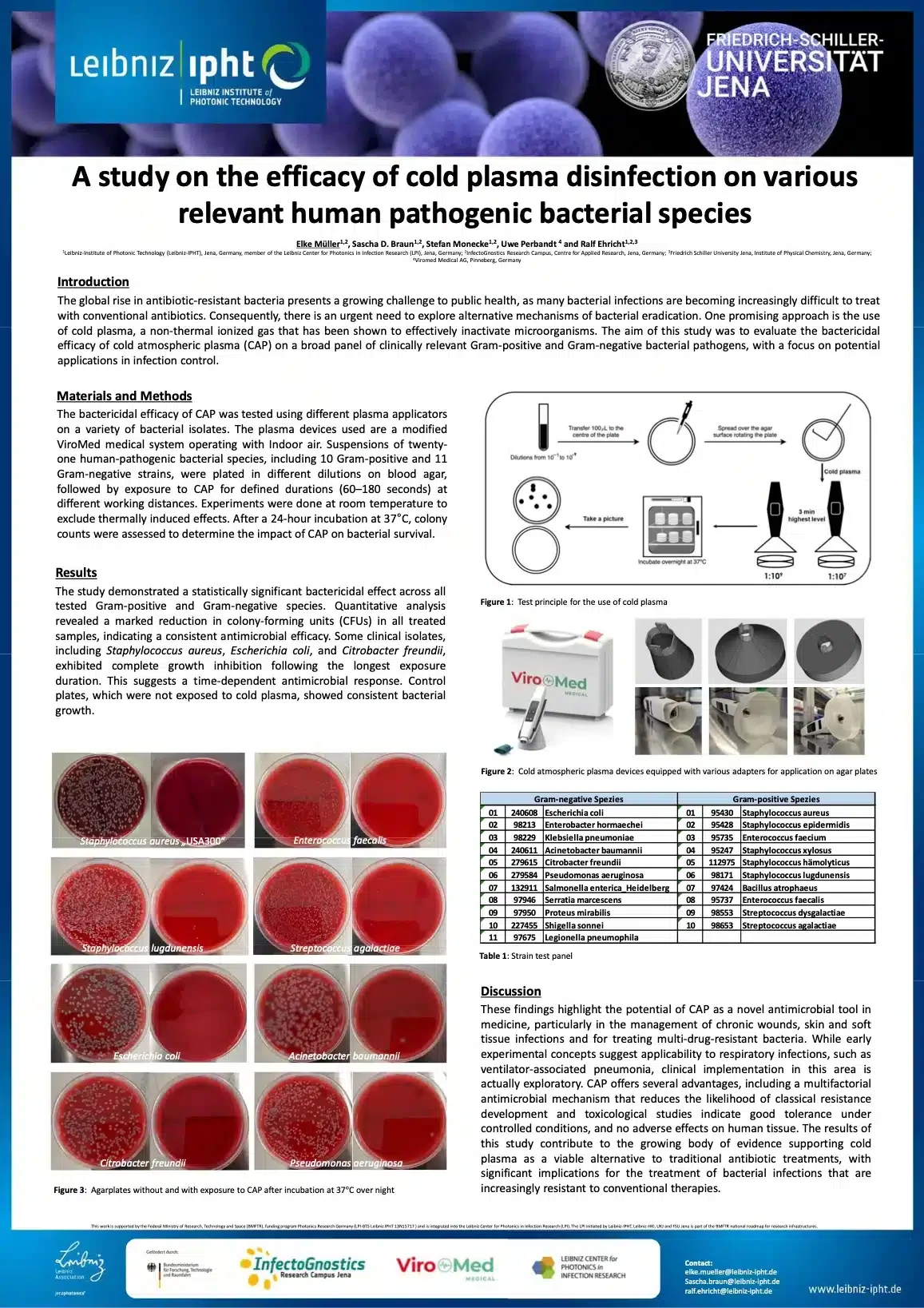
Scientific poster by Leibniz-IPHT on the efficacy of cold plasma against 21 bacterial species that cause disease in humans
Leibniz-IPHT laboratory studyCold plasma against 21 bacterial species

Resistance

A physical approach

Bacteria develop mechanisms against chemical agents. Cold plasma, by contrast, attacks their cell walls physically and at several points at once. According to current knowledge, this makes resistance less likely.[2]

Evidence

Investigated with research institutes

Laboratory studies by Leibniz-IPHT showed a marked reduction of 21 clinically relevant pathogens under controlled conditions.[3] Institutions such as Fraunhofer ISIT, the Helmholtz Centre for Infection Research (HZI) and Hannover Medical School (MHH) are investigating further fields of application.

Outlook

Respiratory tract

Initial in vitro studies suggest that cold plasma could in future help decolonize the airways of ventilated intensive care patients.[9]

Frequently asked questions about cold plasma

What is cold plasma?

Cold plasma is a gas in which some of the electrons have separated from their atoms or molecules. As a result, it contains electrically charged particles, while the gas as a whole remains comparatively cool. In medicine, cold plasma is used, among other things, as a complementary treatment for chronic and infected wounds.[4]

What distinguishes medical cold plasma from a cosmetic plasma pen?

A cosmetic plasma pen for skin tightening works with localized heat. Medical cold plasma is applied at low temperature. In wound treatment, it is intended to reduce the microbial load and support healing.[18]

What does treatment with cold plasma feel like?

The application is often described as causing little pain. On sensitive wound surfaces, it can be uncomfortable or briefly painful. After treatment, the wound may temporarily release more fluid.[4]
More about side effects and safety

How much does cold plasma therapy cost?

The costs depend on the practice, the scope of treatment and the number of sessions. Before starting, ask about the price per session and the expected total cost.
More about the costs of cold plasma therapy

References

  1. Bekeschus, S.; Boeckmann, L.; Thiem, A.; Emmert, S. Die Kaltplasma-Technologie in der Behandlung von Menschen mit chronischen Wunden [Cold plasma technology in the treatment of people with chronic wounds]. J. Dtsch. Dermatol. Ges. 2026, 24 (2), 216–229.
    https://doi.org/10.1111/ddg.70053
  2. Mahmoud, Y. A.-G. et al. Cold Plasma as a Revolutionary Antimicrobial Modality: A Multifaceted Weapon Against Antibiotic Resistance. Antibiotics 2025, 14 (9), 930.
    https://pmc.ncbi.nlm.nih.gov/articles/PMC12466553/
  3. Müller, E.; Braun, S. D.; Monecke, S.; Perbandt, U.; Ehricht, R. A study on the efficacy of cold plasma disinfection on various relevant human pathogenic bacterial species. Poster PS01.167, 77th Annual Meeting of the DGHM, Jena, September 22, 2025. Summary and poster
  4. Deutsche Gesellschaft für Mund-, Kiefer- und Gesichtschirurgie (DGMKG). S2k guideline: Rationaler therapeutischer Einsatz von kaltem physikalischem Plasma [Rational therapeutic use of cold physical plasma], AWMF register number 007-107; 2024.
    https://register.awmf.org/assets/guidelines/007-107l_Rationaler-therapeutischer-Einsatz-von-kaltem-physikalischem-Plasma_2024-08-verlaengert.pdf
  5. Weltmann, K.-D.; von Woedtke, T. Plasma medicine – current state of research and medical application. Plasma Phys. Control. Fusion 2017, 59, 014031.
    https://iopscience.iop.org/article/10.1088/0741-3335/59/1/014031
  6. World Health Organization. Antimicrobial Resistance. Fact Sheet.
    https://www.who.int/news-room/fact-sheets/detail/antimicrobial-resistance
  7. Nicol, M. J. et al. Antibacterial Effects of Low-Temperature Plasma Generated by Atmospheric-Pressure Plasma Jet Are Mediated by Reactive Oxygen Species. Sci. Rep. 2020, 10 (1), 3066.
    https://doi.org/10.1038/s41598-020-59652-6
  8. Filipić, A. et al. Cold Plasma, a New Hope in the Field of Virus Inactivation. Trends Biotechnol. 2020, 38 (11), 1278–1291.
    https://pmc.ncbi.nlm.nih.gov/articles/PMC7164895/
  9. Karrer, S. et al. In Vitro Safety Study on the Use of Cold Atmospheric Plasma in the Upper Respiratory Tract. Cells 2024, 13 (17), 1411.
    https://pmc.ncbi.nlm.nih.gov/articles/PMC11394226/
  10. Küçük, D. et al. Evaluation of efficacy of non-thermal atmospheric pressure plasma in treatment of periodontitis: a randomized controlled clinical trial. Clin. Oral Investig. 2020, 24 (9), 3133–3145.
    https://doi.org/10.1007/s00784-019-03187-2
  11. Hui, W. L. et al. The Emerging Role of Cold Atmospheric Plasma in Implantology: A Review of the Literature. Nanomaterials 2020, 10 (8), 1505.
    https://doi.org/10.3390/nano10081505
  12. Oliver, M. A. et al. Cold atmospheric plasma is bactericidal to wound-relevant pathogens and is compatible with burn wound healing. Burns 2024, 50 (5), 1192–1212.
    https://doi.org/10.1016/j.burns.2023.12.012
  13. Yoo, J. et al. Application of cold atmospheric microwave plasma as an adjunct therapy for wound healing in dogs and cats. J. Vet. Sci. 2023, 24 (4), e56.
    https://doi.org/10.4142/jvs.23067
  14. Bae, M. et al. Therapeutic Use of Cold Atmospheric Plasma for the Treatment of Mild Acne Papulopustulosa – A Randomized, Controlled, Double-Blind Pilot Study. Dermatol. Ther. 2025, 4228323.
    https://doi.org/10.1155/dth/4228323
  15. Karrer, S. et al. A Prospective, Randomised, Controlled, Split-Face Clinical Trial to Assess the Safety and the Efficacy of Cold Atmospheric Plasma in the Treatment of Acne Vulgaris. Appl. Sci. 2021, 11 (23), 11181.
    https://doi.org/10.3390/app112311181
  16. Wang, J. et al. Efficacy and Safety of Cold Atmospheric Plasma-Assisted Therapy for Herpes Zoster: A Randomized, Parallel, Positive-Controlled, Non-inferiority Multicenter Clinical Trial. Dermatol. Ther. (Heidelb.) 2025, 15 (9), 2391–2408.
    https://doi.org/10.1007/s13555-025-01467-2
  17. Gupta, A. K. et al. Utility of devices for onychomycosis: a review. J. Dermatolog. Treat. 2023, 34 (1), 2265658.
    https://doi.org/10.1080/09546634.2023.2265658
  18. German Federal Ministry for the Environment, Climate Action, Nature Conservation and Nuclear Safety. FAQ C.04: Welche Fachkundeanforderungen muss ich für Anwendungen mit Plasma-Pens erfüllen? [What expertise requirements do I have to meet for applications with plasma pens?] As of March 11, 2024.
    bundesumweltministerium.de (in German)
Questions about cold plasma?

We advise practices, hospitals and care facilities on the use of cold plasma and on our ViroCAP handheld devices.