Medical practices
Treatment and waiting rooms where many people come together.
KLINIK AKUT V 500 Plasma
The KLINIK AKUT V 500 reduces aerosols in room air and inactivates viruses and bacteria – with cold plasma, UV-C catalysis and ionization. For treatment and waiting rooms, reception areas, pharmacies and offices.
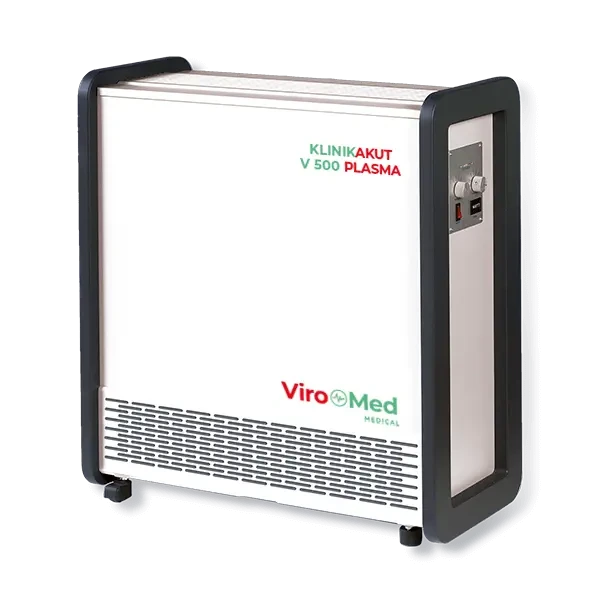
In enclosed spaces, viruses and bacteria can spread via aerosols – tiny suspended particles that are produced when breathing, speaking or coughing and remain in the air for a long time. The KLINIK AKUT V 500 circulates the room air, filters aerosols and inactivates germs inside the unit.
Unlike air purifiers that rely exclusively on UV-C radiation, the unit combines several methods: cold plasma, electrostatic filtration, UV-C catalysis and ionization. The Viromed technology has been studied at three universities.
Physical
Excited molecules and charged particles release their energy at the membrane of bacteria, including as local heat that is sufficient to perforate the membrane. If bacteria become charged in the plasma, their structure can deform in such a way that cracks form.
Chemical
An OH molecule removes an H atom from the membrane and combines with it to form H₂O. The water molecule escapes and leaves a defect in the membrane – a small hole.
How it works
Germs in the intake air are inactivated inside the unit. Through ionization, the V 500 also acts in the room itself, on newly arriving viruses in the air.
A quiet fan with a brushless motor circulates the room air at a high flow rate and quickly dilutes aerosols with air that has already been cleaned.
Cold plasma generates oxygen radicals that attack the cell structures of microorganisms. Viruses, spores, fungi, pollen and odors are inactivated. The ozone produced in the process is neutralized by an activated carbon filter in stage 5.
Through electrostatic charging, inactivated germs, allergens and fine dust are filtered out of the air.
Strong UV-C radiation destroys the genetic material of germs; a titanium dioxide coating catalytically breaks down organic substances, odors and volatile pollutants.
The interplay of pre-filtration, photochemical disinfection, catalytic oxidation and microfiltration ensures hygienic air conditions; an activated carbon filter neutralizes ozone.
The cleaned air is enriched with ions. Positive and negative ions can attach to viruses in the room air and damage their surface proteins; particles and allergens are bound through cluster formation.
Study
The Institute of Fluid Mechanics and Aerodynamics at the Bundeswehr University Munich examined the KLINIK AKUT V 500 for its suitability for reducing aerosols (Kähler, Fuchs, Hain, 2020; financially supported by Viromed).
Important to know
Room air disinfection units protect against indirect infection via aerosols in the room. Against direct transmission at short range, distance and, where appropriate, respirator masks continue to help.
Areas of use
Treatment and waiting rooms where many people come together.
Common rooms, examination rooms and meeting rooms.
Sales areas with high customer traffic.
Meeting rooms and workrooms where people spend longer periods together.
We advise you on room size, number of units and placement. The units are delivered by our technical customer service.
Phone
Advice
Orders