Acute and chronic wounds
To complement the care of injuries, for example after a heel tread injury in a horse.
ViroCAP vet
A handheld device for veterinarians in small animal practices and equine clinics.

Cold atmospheric plasma is being studied as a complement to wound care. An evaluation of treatment courses in dogs and cats showed that the wound area decreased faster during the complementary cold plasma treatment than in the preceding phase with standard care alone.
Source: Yoo, J. et al. Application of cold atmospheric microwave plasma as an adjunct therapy for wound healing in dogs and cats. J. Vet. Sci. 2023, 24 (4), e56. https://doi.org/10.4142/jvs.23067
To complement the care of injuries, for example after a heel tread injury in a horse.
For accompanying wound care after veterinary procedures.
These include hot spots, eczema and abscesses as well as fungal and bacterial skin infections.
For accompanying care in hoof and claw infections.

Article
Causes, course and treatment of mud fever, and how cold plasma can support it.
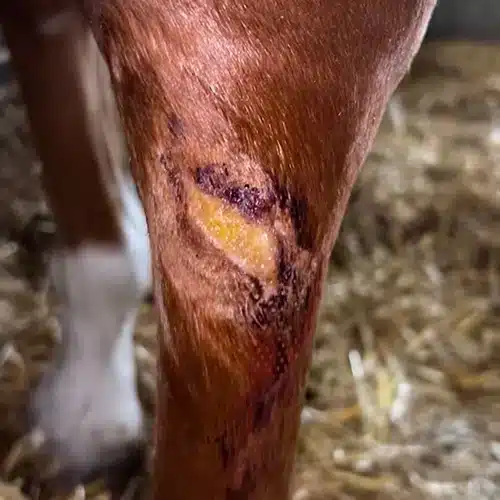
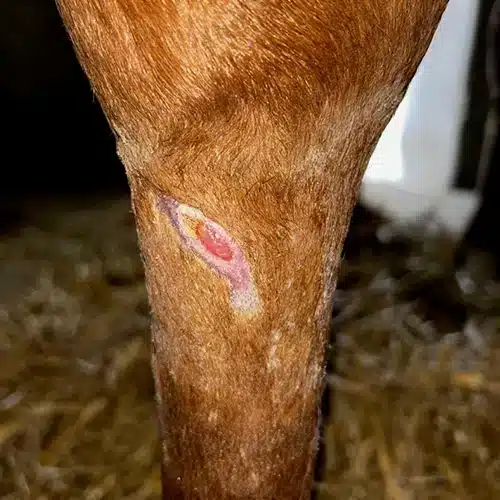
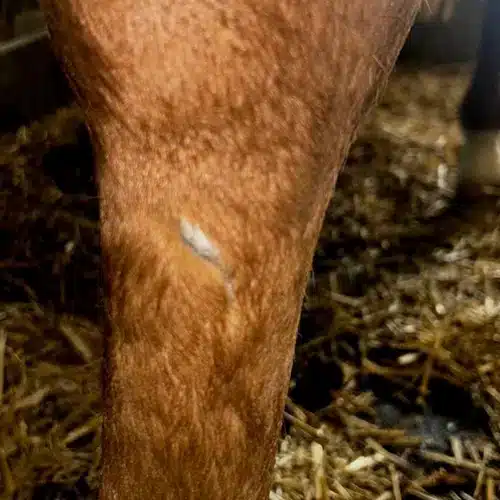
 Initial situation
 After 2 treatments
 After 3 treatments
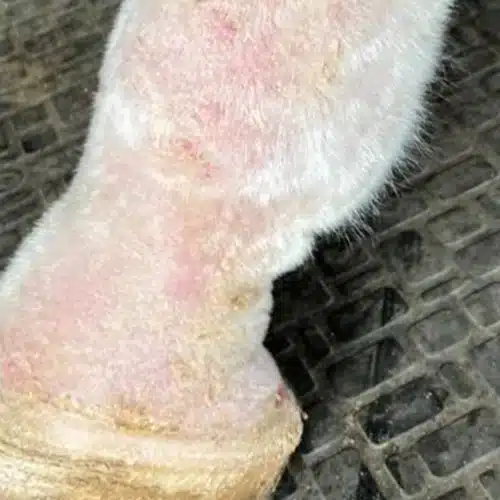 After 4 treatments
The horse was treated with cold plasma 4 times within just under 3 weeks.
 Initial situation
 After 1 treatment
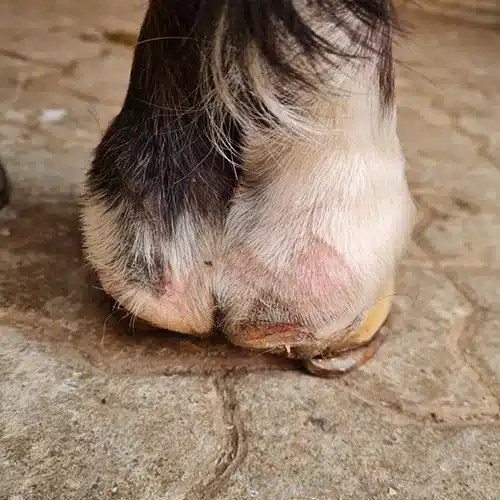 After 3 treatments
Daily dressing change with Lavanox for cleansing, polyhexanide wound dressing + Lavanid gel, hoof bandage; cold plasma therapy. Cold plasma therapy was applied for 2 minutes per area.
Quickly healed wound that showed no signs of inflammation during the course. Treated without antibiotics or anti-inflammatory drugs.
K. Homann, Hannover Medical School
 Initial situation
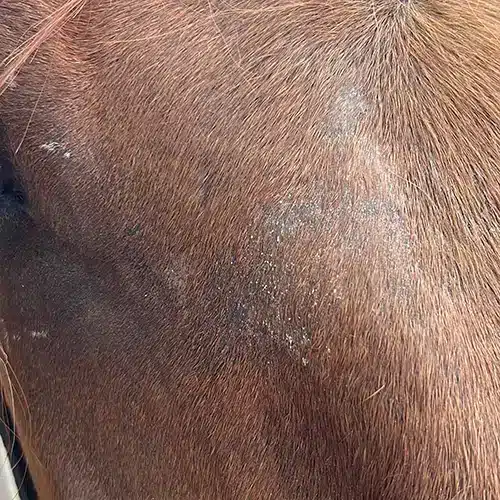 After 2 treatments
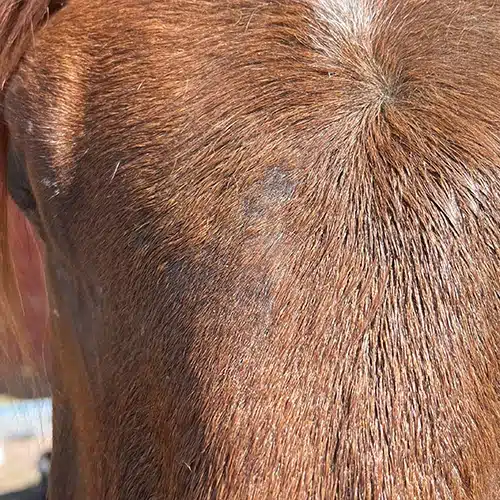 After 4 treatments
The horse was treated with cold plasma 4 times within just under 3 weeks.
 Initial situation
 After 5 treatments
 After 7 treatments
The yearling had been brought home from the rearing farm; on arrival in its own stable, a flat wound about 15 cm long and 3–4 cm high was discovered on the carpal joint. Clear signs of inflammation with marked hypergranulation, purulent exudate and fibrin deposits. The first treatment was carried out by the veterinarian, who partially removed the hypergranulation surgically, shaved the wound area and prescribed oral antibiotics and anti-inflammatory drugs.
Cold plasma therapy was started after the veterinary treatment. Beforehand, the wound was cleaned mechanically with 0.9% NaCl and gauze swabs and dabbed dry. This was followed by cold plasma treatment and cleansing with Serasept; because of increased exudate, Aquacel Ag was used as a wound dressing and secured with padding and a hook-and-loop bandage. Initially, the dressing was changed daily (until February 4, 2025), every two days from February 4, 2025, and the wound dressing was switched to Kendall AMD foam dressing and Lavanox. Cold plasma treatment was carried out at every dressing change, 7 times in total for 30 seconds per area.
Quick healing of the wound; the infection subsided rapidly even though it was a young horse from the rearing farm; the cold plasma therapy was well tolerated and easy to use.
K. Homann, Hannover Medical School
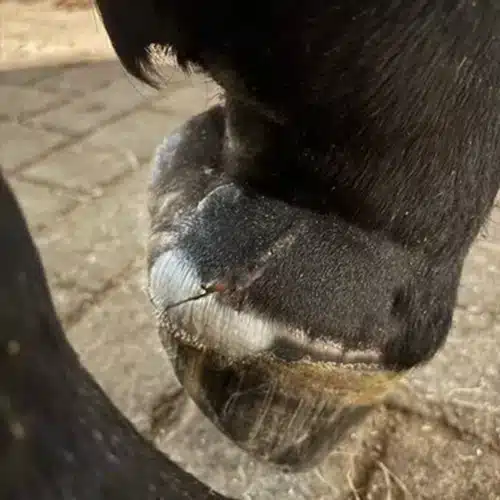 Initial situation
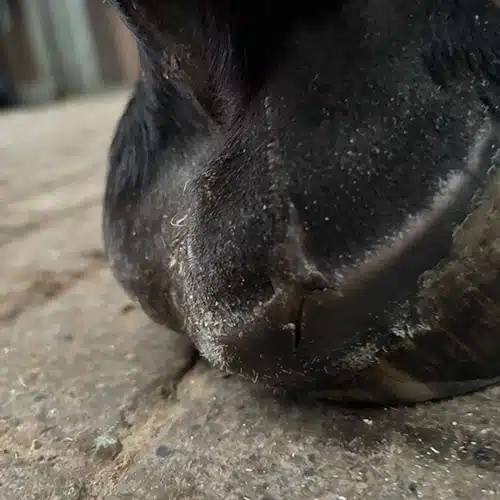 After 3 treatments
Daily dressing change with Lavanox for cleansing, polyhexanide wound dressing + Lavanid gel in the pocket, hoof bandage; cold plasma therapy. Cold plasma therapy was applied for 2 minutes per area.
Quickly healed wound that showed no signs of inflammation during the course. Treated without antibiotics or anti-inflammatory drugs.
K. Homann, Hannover Medical School
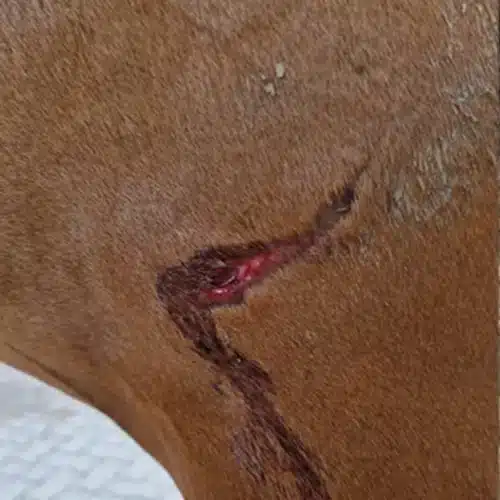 Initial situation
 After 1 treatment
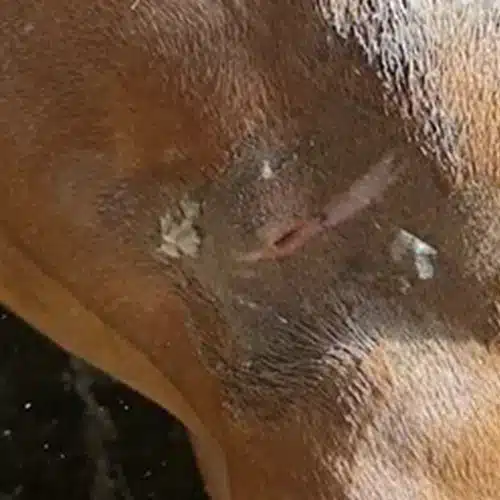 After 5 treatments
Daily dressing change with Lavanox for cleansing, Aquacel Ag wound dressing, cold plasma therapy. Cold plasma therapy was applied 5 times in total for 2 minutes per area.
Well-healed wound that showed no signs of inflammation during the course. Treated without antibiotics or anti-inflammatory drugs.
K. Homann, Hannover Medical School
 Initial situation
 20.08.
 04.09.
 10.09.
On August 4, 2025, a laceration after a kick was presented. As the injury was already more than 24 hours old and the horse was too restless to be sutured, the wound was treated conservatively. At the start it showed a fibrinous coating but no signs of inflammation.
During the first two weeks, the wound was dressed every two days: thorough irrigation with Lavanox, Aquacel Ag as wound dressing, covered with Snögg Foam. In parallel, cold plasma treatment was carried out at every dressing change, starting with 4 minutes per area. The wound size decreased rapidly: 5 cm × 1.5–2.0 cm on August 4, 2025, 4 cm × < 1.5 cm on August 20, 2025 and 2 cm × < 1.0 cm on September 4, 2025. From August 26, 2025, the treatment frequency could be reduced to twice a week because the wound was free of irritation and dry. On September 10, 2025, the wound had completely healed and a bandage was no longer needed.
The injury healed quickly and without complications, with a steady reduction in size and no signs of inflammation. Treatment was carried out without antibiotics or anti-inflammatory drugs, which underlines the good local wound care and the effectiveness of cold plasma therapy.
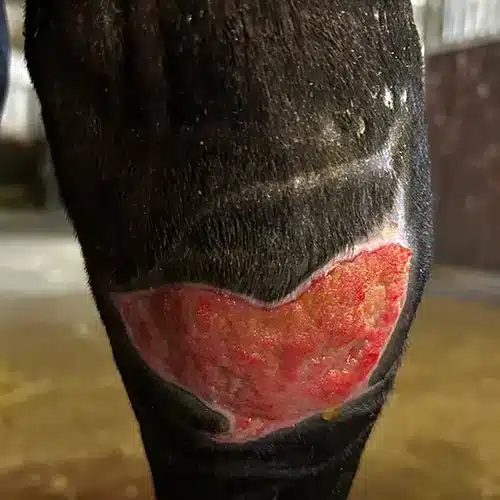
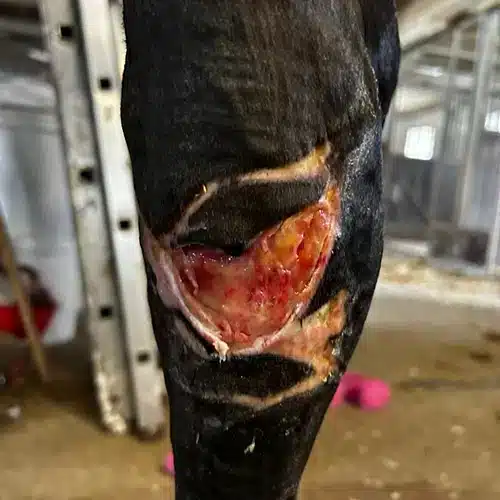 Initial situation
 18.08.
 13.09.
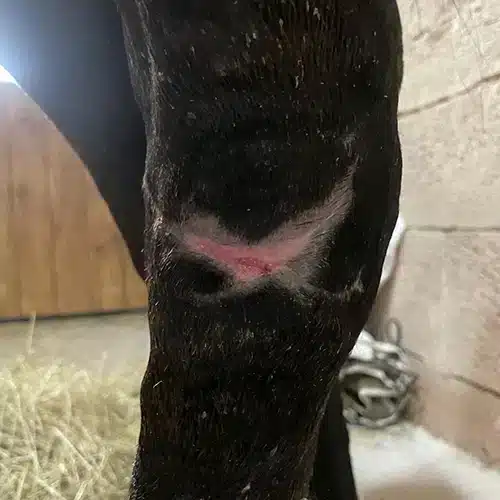 01.11.
On June 20, 2025, the horse sustained a severe injury after getting caught in electric fence tape. This caused deep lesions with bruising, some reaching down to tendons, ligaments and the joint. After three days of inpatient care at the clinic, the wound was treated further on an outpatient basis. In August, during a vacation-related absence, a clear infection with hypergranulation, purulent exudate and redness appeared after a dressing change. The horse then briefly received oral antibiotics from the veterinarian.
Wound care was initially carried out every two days with Sera Sept for cleansing, Lavanid wound gel and a wrap bandage. During the infection phase (August 18–31, 2025), dressings were changed daily, complemented by cold plasma therapy (initially 12–16 minutes). Once the inflammation had subsided, the frequency could be reduced to every two days again. Over time, the wound size steadily decreased from an initial 10 × 12 cm to 4 × 2 cm. The surface became increasingly free of irritation and clean, and the skin adapted evenly.
Despite the extensive injury close to the joint and an interim infection, healing was quick and free of complications. Tendons, ligaments and the joint remained intact. After the wound environment had stabilized and with consistent local therapy, the wound healed completely.
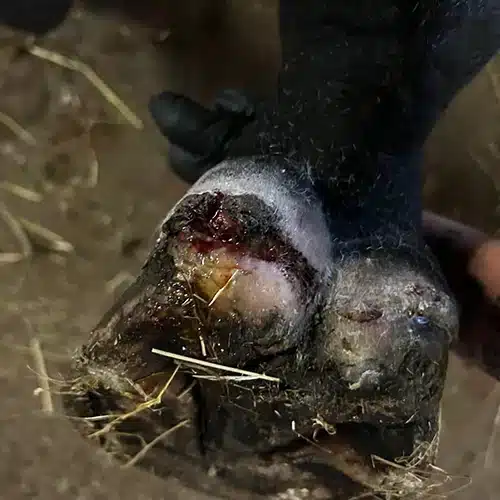 Initial situation
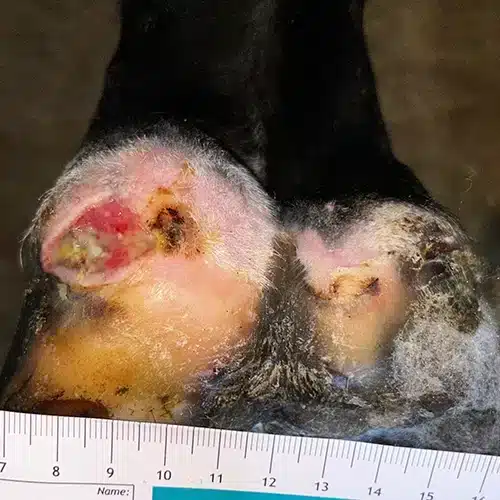 13.10.
 24.10.
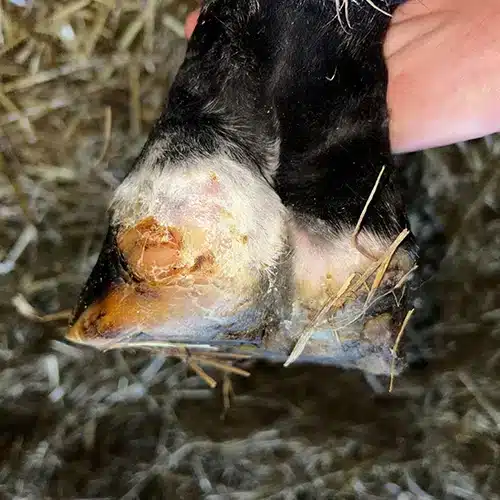 30.10.
On October 10, 2025, an 8-year-old warmblood mare was presented with an infected pressure point in the hoof area, caused by a poorly fitting hoof bandage with cast. The wound showed clear signs of infection: foul odor, purulent-serous exudate, redness, swelling and a depth of up to 1 cm.
Therapy was initially carried out every two days. After thorough irrigation with Lavanox, the wound was covered with Suprasorb X + PHMB and dressed with a sturdy hoof bandage up to the pastern. In addition, cold plasma was applied at every dressing change (initially 4 minutes per area). After only three days, the wound condition had clearly improved: the swelling went down, the wound was free of irritation with a fibrinous coating and without foul odor. Over time, the treatment frequency could be reduced to twice a week and the duration of the plasma application gradually shortened from 4 to 2 minutes per area. On October 24, 2025, only a dry, non-irritated wound about 1 cm long remained; on October 30, 2025, the wound had completely healed.
Throughout the treatment period, the wound healed continuously and quickly, with a rapid decline in signs of inflammation. Complete healing was achieved without antibiotics or anti-inflammatory drugs.
Would you like to learn more about cold plasma technology or order ViroCAP vet for your practice? Our team will be happy to advise you personally and answer all your questions about areas of use, handling and cost-effectiveness.
Phone
Advice
Orders