Laboratory study: Cold plasma against 21 bacterial species
Together with Viromed, the Leibniz-IPHT in Jena investigated how cold atmospheric plasma affects the growth of 21 pathogenic bacterial species. The research team presented the results in 2025 at the annual meeting of the German Society for Hygiene and Microbiology (DGHM).
Key points
- Result:After cold plasma treatment, significantly fewer bacterial colonies formed for all 21 species tested than on the untreated control plates. In some samples, no growth was detectable after the longest treatment time.
- Significance:The study examined bacterial cultures on agar plates using a modified test device. This experiment alone does not show whether cold plasma also helps in the treatment of infections.
Why this study?
More and more bacteria are resistant to common antibiotics. Infections with these pathogens are harder to treat, especially in chronic wounds and in skin and soft tissue infections. This is why methods are needed that kill bacteria in a different way than antibiotics. One of them is cold atmospheric plasma: an ionized gas that produces reactive oxygen and nitrogen compounds, UV components and electric fields at room temperature.
The aim of the Jena research group was to test the bactericidal effect of cold plasma on as broad a range of clinically relevant pathogens as possible, rather than on individual species only, as in many earlier studies. You can read more about how it works on the page Cold plasma technology.
How the experiment was carried out
- 1
Plating the bacteria: Suspensions of the 21 bacterial species were applied to blood agar plates in various dilutions.
- 2
Treating with cold plasma: The plates were exposed to cold plasma for 60 to 180 seconds, with different working distances and attachments. The plasma source was a modified Viromed medical system that works with ambient air.
- 3
Ruling out heat effects: All experiments were carried out at room temperature so that any effect could not be due to heating.
- 4
Evaluation: After 24 hours at 37 °C, the colonies were counted and compared with untreated control plates.
These 21 bacterial species were tested
The test panel includes typical pathogens of wound, skin and hospital infections, including Staphylococcus aureus, Pseudomonas aeruginosa, Acinetobacter baumannii and Klebsiella pneumoniae.
10 gram-positive species
Nr.
Bacterial species
01
Staphylococcus aureus
02
Staphylococcus epidermidis
03
Enterococcus faecium
04
Staphylococcus xylosus
05
Staphylococcus haemolyticus
06
Staphylococcus lugdunensis
07
Bacillus atrophaeus
08
Enterococcus faecalis
09
Streptococcus dysgalactiae
10
Streptococcus agalactiae
11 gram-negative species
Nr.
Bacterial species
11
Escherichia coli
12
Enterobacter hormaechei
13
Klebsiella pneumoniae
14
Acinetobacter baumannii
15
Citrobacter freundii
16
Pseudomonas aeruginosa
17
Salmonella enterica serovar Heidelberg
18
Serratia marcescens
19
Proteus mirabilis
20
Shigella sonnei
21
Legionella pneumophila
Results
Cold plasma markedly reduced the number of colony-forming units for all 21 bacterial species; the authors report a statistically significant bactericidal effect on all gram-positive and gram-negative species. The untreated control plates showed normal growth throughout.
For some clinical isolates, namely Staphylococcus aureus, Escherichia coli and Citrobacter freundii, no growth was detectable after the longest treatment time. The longer the plates were treated, the stronger the effect. The research group interprets this as a time-dependent antimicrobial effect.
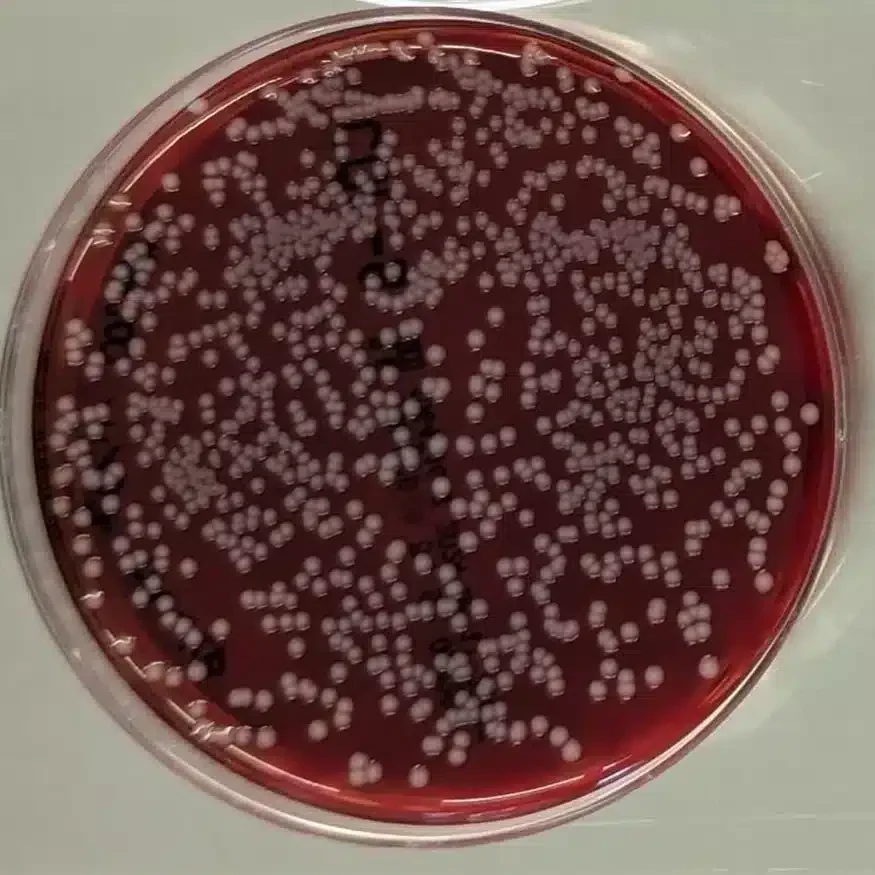
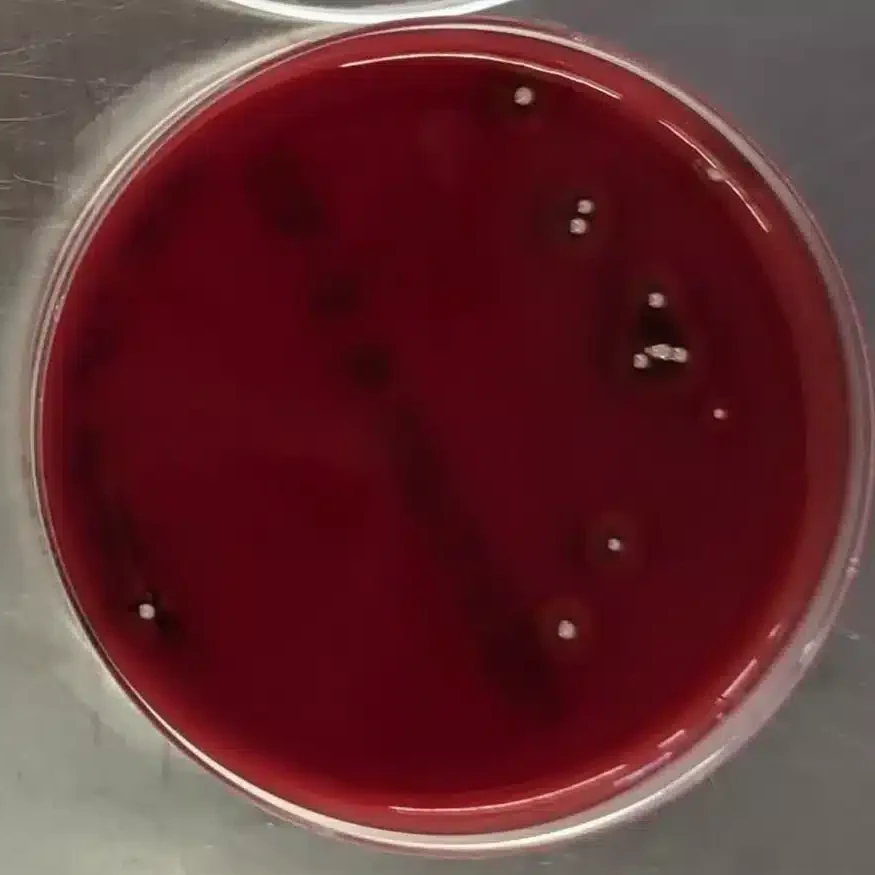
MRSA strain “USA300” from the test series, dilution 1:10⁷. Left: the untreated control; right: after 3 minutes of cold plasma at the highest setting.
How the research group assesses the results
The authors see cold plasma as a possible new antimicrobial tool, especially for chronic wounds, skin and soft tissue infections and infections with multidrug-resistant pathogens. As an advantage, they cite its mechanism of action with several simultaneous points of attack, which makes the development of classic resistance less likely. They explicitly describe its use in respiratory infections, such as ventilator-associated pneumonia, as exploratory at present.
What the study does not show
- Laboratory conditions:Bacteria were tested on agar plates. The experiment does not reproduce biofilms, wound exudate and tissue as found in real wounds.
- Test device:A modified system with various attachments was used. The results cannot be transferred one-to-one to a specific production device.
- Conference poster:The results are available as a poster presentation, not as a peer-reviewed journal article. The poster does not give detailed reduction rates or statistics.
- Involvement:Co-author Uwe Perbandt is a member of the Management Board of Viromed Medical AG. The work was funded by the German Federal Ministry of Research, Technology and Space (BMFTR, grant number 13N15717).
Whether and how well cold plasma prevents or treats infections in patients must be shown by clinical studies. The use of a medical device is always governed by its intended purpose and instructions for use. The page Cold plasma in medicine gives an overview of the state of clinical research, and the page Safety and side effects covers risks and tolerability.
PDF download
The original poster
Müller E, Braun SD, Monecke S, Perbandt U, Ehricht R: A study on the efficacy of cold plasma disinfection on various relevant human pathogenic bacterial species. Poster PS01.167, DGHM 2025 (English, 1 page).
Viromed editorial team
Summary of the poster without any additions of our own to the results. For questions about the study, please contact the Leibniz-IPHT; for questions about cold plasma medical devices, contact Viromed.